Charlton VS Mighty MLJ

Thursday, March 17, 2011

DC Dopplegangers: Sensational Shields

As previously mentioned, DC Comics had rolled out their own Crusaders in the late 1970s to play to part of foils for the Freedom Fighters. Based on Marvel's Invaders, leading to an unofficial crossover as each team battled amalgams of the other, there were traces of Mighty Comics' Mighty Crusaders and their supporting characters.

The most obvious comparison is between Americommando and his 1940 template, the Shield. Besides their red, blue and while plumage which they are arrayed in, they sport stripes, stars, and flowing locks atop their non-traditional masks.

Additionally, each has an indomitable spirit driving them to support their causes. However, while for the Shield it is freedom and peace for all, for Americommando it is to subjugate the masses with his Nazi ideology. Yep, he's really the Silver Ghost underneath.

What's interesting is that in his criminal alias, the Ghost has the ability to turn humans into silver... something the Shield wouldn't like since his foe the Eraser turned him into an iron statue for decades. Hence, of these two, Commando trumps over his adversary in battle.

Tuesday, March 15, 2011

DC Dopplegangers: Sultry Sea-Supers

As previously mentioned, DC Comics had rolled out their own Crusaders in the late 1970s to play to part of foils for the Freedom Fighters. Based on Marvel's Invaders, leading to an unofficial crossover as each team battled amalgams of the other, there were traces of Mighty Comics' Mighty Crusaders and their supporting characters.

No line of characters is complete without the sea-faring superhero, and the Crusaders each had one... sort of. Actually over at Mighty Comics, shortly before her love interest Jaguar met up with that league of legends and decades before joining them, the pheromone feline flummoxed fighting feline met the sea circe herself, Kree-Nal.

No, she was not related to Captain Mar-Vell although she was likewise part of an alien invasion, in her case an invasion of one. DC's Crusaders had the Baracuda, formerly an unassuming fanboy who was solicited by uber-Nazi the Silver Ghost to be recruited into his faux-World War II team of heroes. Turned into a man-beast with flight and mighty to exercise his right to fight, Barracuda had like his teammates proved easily dispatched by Quality Comics' finest.

And in a battle between these two wet warriors, Kree-Nal would have the upper hand simply because she can mutate and control any sea life, and that includes a faux-Sub-Mariner. Additionally, what gill breather would not be intoxicated by this bewildering beauty???

Sunday, March 13, 2011

DC Dopplegangers: Fearless Fireballs

As previously mentioned, DC Comics had rolled out their own Crusaders in the late 1970s to play to part of foils for the Freedom Fighters. Based on Marvel's Invaders, leading to an unofficial crossover as each team battled amalgams of the other, there were traces of Mighty Comics' Mighty Crusaders and their supporting characters.

Interestingly, each team sported their own "Fireball". named the same with similar flame-wielding abilities. Of course, Ted Tyler was a firefighter while old Lennie Wein was a fanboy, so while one was a professional hero the other was an amateur nerd. 

Nevertheless, in a mano-y-mano fight between the two human torches, it would seem Fireball-DC would have the upper-hand on Fireball-MLJ, since he in enveloped in all-consuming flames enabling to create tangible shapes and defy gravity, while his opponent merely could absorb and control ambient heat around him... oh and leap mighty bounds. Still, he had girlfriend Hedy (Hedy?) Harris pulling for him, instead of a junior sidekick named Sparky. That has to count for something in the grand scheme of plot developments.

Saturday, March 12, 2011

Mighty Crusaders in a Parallel Universe

Sure DC Comics tried their hand at Archie's Mighty Crusaders brand twice, in the modestly successful !mpact line of the 1990's and more recently the Red Circle series of in-continuity publications more recently.

What most are unaware of is the first appearance of the Crusaders... not those ones exactly... rather the foils for the Freedom Fighters.

Consisting of pastiche versions of Marvel's Invaders, from Americommando (Captain America), Rusty (Bucky), Baracuda (Namor the Sub-Mariner), Fireball (Human Torch) and Sparky (Toro), these were actually four fan boys empowered by supervillain Silver Ghost seeking revenge on his old foes.
  • Immediately, there is a tip-of-the-hat to the Shield in A-Commando's uniform, head gear, even his own shield.
  • Baracuda channels a bit of Jaguar's girlfriend Kree-Nal in the underwater motif and alien skin pigmentation.
  • Fireball and his MLJ counterpart would definitely have a volatile relationship, energized by equal parts ability and angst.
  • Rusty and Shield's long lost sidekick Dusty could swap tales of goofy names and such.
  • Sparky would encounter a grown-up Inferno whose bad breath matches his own.
  • This would lead the rest of Archie's Crusaders to face DC's Crusaders, i.e. Phantom Lady vs Darkling, Human Bomb vs Comet, Uncle Sam vs Captain Flag, Dollman and girlfriend Martha vs Fly and Fly Girl, Firebrand vs Firefly, Black Condor vs Black Hood, Happy "Ray" Terrill vs Lancelot "Shield" Strong. COOL!
Still, these latecomers of the underwear-clad set were quickly dealt decisive blows by the Quality Comics gang, so the similarly obscure MLJ crew wouldn't have a problem with these also-rans.

Friday, March 11, 2011

Action-Heroes in a Parallel Universe

What may have been in a parallel universe, had DC Comics published the Action-Heroes in the mid to late 1960s rather than Charlton.

When you get down to it, some stark realities reveal themselves through this exercise:

  • All of these characters except one (Adam Strange) were principally defined by the teams they joined.
  • Two had their own self-titled comics (Atom and Karate Kid...although Strange had a mini-series later).
  • All were all zapped by energies (Thunderbolt/solar/Zeta/White Dwarf/chronological) which sent them to unexpected locales throughout the multiverse. 
  • All of them were B-level characters that shined most when they were underestimated by those around them.
And all of them are near spitting images of their brethren over at Derby, if form if not always in substance.

Wednesday, March 2, 2011

Getting Some Pep Into Your Step: Hangman vs Mother Goose!

Let's get some "Pep into your step" with a truncated tale from Pep #30 featuring the Hangman, prior to his radically rotten disposition as mid-60's villain turned mid-80's paternal ogre. An interesting diametric involves the relationship with he and his Charlton counterpart Punch's blond bombshells, the ever alluring Thelma (aka the "hand-me-down" girlfriend...sorry Comet your bro called dibs when you evaporated) and always evil Jewelee. Not to mention each having a propensity towards...well... goofiness despite the malevolence they try to exude.

Anyways, here we go...

Okay, so we understand around this time that Mad Hatter was already booked for an engagement with a certain Dark Knight detective, but couldn't this erstwhile earl of the eerie have found a better opponent than this creepy crone?

Yikes! On the trail of this pointy-hat predator, after she dealt with two of three sons in a mysterious Dickson family (wait... Dickson... Dickerson... could it be a connection? Or rather, the writer's laziness), our Stringed Sentinel is... roped... into a dangerous situation. Egads, however will he procure himself out of this situation? Never fear, gentle reader...

Well said, Punch, although we doubt Jewelee could get her hair stay immaculately pristine in windstorm quite like Thelma. Either she used a six-pack of hairspray of bobby-pins galore.

And speaking of the fairer sex... no fair throwing us a curve ball... a vengeful dude in drag? Sigh, face it he ain't no Captain Swastika, who had a better costume even though half of it was mere dress slacks.

Stay tuned for more installments of "Getting Some Pep Into Your Step".


Saturday, February 19, 2011

DC Dopplegangers: Webhead Writers

Beating our favorite webhead to the printer a full nine months before his debut in 1942, there was the Tarantula busting on the scene with the Web waiting in the wings.

An obvious comparison between the two with several points of similarity:

  • Jonathan and John, as in Mr. Law and Mr. Raymond.
  • A noted mystery writer and a criminologist. The former dabbled in crime fiction and the latter in chronicling his profession.
  • Neither willing to mat down their blond locks, they each wore half-faced masks.
  • Both had a leaning towards using webs in the modus operandi and tools.
  • Each battled crime during World War II solo while at times alongside others.
  • They had short published runs, with Tarantula's lasting 19 issues of Star-Spangled Comics and Web's lasting 12 issues of Zip Comics.
Once more, B-listers on their absolute best days yet breaking the mode in their non-traditional backgrounds and sense of style.

DC Dopplegangers: Restless Reporters

Steve Ditko was the superstar artist seeking creative freedom throughout his career. Rarely achieving his ideal setting to unleash his unorthodox take on art and storytelling, at least twice he struck a similar cord. The result were two potential legends.

The Question debuted in 1967 as a backup feature of Derby Connecticut's Charlton Comics' Blue Beetle, for five issues. A sixth issue of the hero's adventures were compiled in Mysterious Suspense in 1968.

The Creeper debuted in 1968, after his former employer's superhero action line essentially folded (the Phantom not withstanding) in an issue Showcase before six issues of his self-titled series. And besides having short-lived runs before being revived years later, each had other similarities:

  • Jack Ryder and Vic Sage were temperamental television personalities who espoused the ideals of their creator of objectivism, although Jack much less so.
  • Each had a blonde coworker at their television stations that struck just as many nerves and heartstrings of our heroes.
  • In their costumed identity, intelligent scientists bestowed them with devices that transformed them from well known television personalities into notorious heroes.
  • Law enforcement authorities had an edgy relationship with this pair, with their most consistent allies being blue garbed millionaires Batman and Blue Beetle.
While never achieving the limelight of A-list heroes from the main publishers, each gained an appreciative fanbase which allowed them time and again to return, most of the time beside their fellow crusaders.

Tuesday, February 1, 2011

Archie Doesn't Like the Watchmen

If looks could kill, watch the daggers flying from the Archies' eyes gazing upon our heroes! They just aren't into Alan Moore in Riverdale, I suppose!?! More of a Springdale thing, me thinks...

Saturday, January 29, 2011

The Black Hood Wants You: To Tune Out...

While never achieving animated fame, at least one member of the Mighty Crusaders did reach a modest level of priminence in another medium. Which seemed to be a harbinger of a revival two decades later in the form of "Radio Comics", predecessor to Mighty/Red Circle Comics.
Kip Burland aka the Black Hood was featured in a radio drama that aired from July 7, 1943 until January 1944, consisting of 120 episodes of fifteen minute episodes each. Starring the voices of Scott Douglas as the signature character and Marjorie Cramer as his girlfriend Babs, the series was noted as mostly pedestrian since stringent broadcast standards prohibited the more violent elements featured in the comics of that decade.

An excellent resource for this obscure series can be found at the Mighty Crusaders website as well as other items of interest on the Archie heroes.


Thursday, January 27, 2011

Archie Animated: The End of a Cult Classic

The Archies had all the makings of a perpetual plethera of plentiful plots from the published pandering to the prepubescent crowd. And then... something happened to cause the dominant freight train of Saturday mornings to come to a screeching halt! And now part two from http://www.memorabletv.com/tvsgreatesthits/archies.htm


But the series took an unexpected plunge in popularity with The U.S. of Archie made in 1974. Designed as a mingling of history with entertainment, it found the gang going back in time in such plots as working with Harriet Tubman on the Underground Railroad for slaves during the 1800s. Such serious concerns were off-kilter for the normally light series, and it disappeared from Saturday mornings in 1975. Its last season on CBS consisted of U. S. of Archie repeats. NBC tried repeats of earlier shows in 1977 under the ride The Bang-Shang Lalapalooza Show, but it flopped too.
Nearly a decade later, NBC gave the property another try under the title The New Archies. The characters became prepubescent in this instalment, with a few modifications made for the properties to accommodate the 1980s. Some were substantial (Eugene the egghead and Amani the nice girl finally integrated previously lily white Riverside), others were subtle (Pop's Chok'lit Shoppe was now Pop's Video Cafe). Even Hot Dog became an English terrier. The emphasis remained on jokes and hijinks, but without the music and peppy atmosphere, this edition looked decidedly inferior to the earlier cartoon. There were two stories used in each show, and the 1988?89 season consisted of repeats.

Besides the comic book and cartoons, there was a radio sitcom titled Archie Andrews on Mutual from 1943-44 and NBC from 1946-53. Additionally, ABC commissioned unsold sitcom pilots for the show in 1962 and 1976, and there was a lousy live-action NBC TV movie in 1990 titled Archie: To Riverdale and Back Again, starring Christopher Rich as Archie, in which the characters appeared in middle age.

Wednesday, January 26, 2011

Archie Animated: The Man Behind the Music

Continuing in our last installment of the animated Archies series, which began in the late 60's, we present the man behind the redhead that became a cult classic... Ron Dante. This from the Classic Bands website:

The Archies were a bubblegum pop group that had a #1 hit, appeared frequently on Saturday morning television, and put out three hit albums. However, despite this success they never did any live performances or touring. Why? Because they were cartoon characters.

The Archies began their animated lives when The Archie Show debuted on Saturday morning in September of 1968. Each episode featured a song and dance segment performed by the characters. The show’s music was supervised by Don Kirshner, the man who put together the music for The Monkees. Kirshner tapped veteran pop producer Jeff Barry to put together the snappy, kid-friendly songs The Archie Show needed.

The Archies’ songs were also issued as singles. The first one, “Bang-Shang-A-Lang,” was a #22 hit on the pop charts and got the band off to a good start. But it was a song released the next year that won the animated band its biggest success. “Sugar Sugar” was an infectious tune built on rich boy-girl harmonies and a catchy instrumental hook played on the xylophone. It went to #1 in the summer of 1969, selling six million copies and knocking The Rolling Stones off the top of the charts in the process. The group also enjoyed another Top 10 hit in 1970, with "Jingle Jangle", before "bubble-gum" music gave way to disco.

The group is also notable for the singers who provided the voices of The Archies, all of whom went on to successful careers. Ron Dante, who sang all the lead vocals, went on to sing other bubblegum hits like “Tracy” and produced most of Barry Manilow’s chart successes in the seventies. Ellie Greenwich and Toni Wine, the female vocalists, enjoyed lengthy careers as a songwriter and session vocalist, respectively. Another backup singer, Andy Kim, had a #1 hit in 1974 with a solo song, “Rock Me Gently.”

Tuesday, January 25, 2011

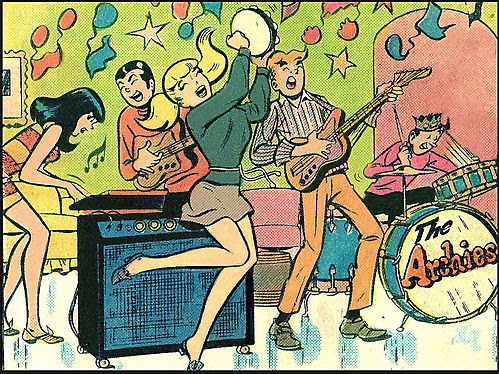
Archie Animated: The Start of a 60's Cult Classic!


Following on last weeks (admittedly) extensive review of the limited amount of animated appearances by characters formerly of Charlton Comics, we now turn our attention to Mighty MLJ's cartoon output...

...if you are listening to crickets churp, its because none of the superheroes in the Mighty MLJ stable ever made the jump to the big screen, in that format. Or much of any aside from marketing purposes for the ill-fated Mighty Crusader action figure line. However, that publisher's bread and butter, the Archie franchise, made a serious impact. So without further adieu, we consider the impetus of a nationwide sensation beginning in 1968. From Memorable TV Dot Com:


The number one cartoon of 1968?69 by a huge margin, The Archies had success beyond its ratings: it revived interest in the Archie character, which had been seen in comic books since 1941; it showed the appeal of silly jokes, teenagers, and music to the Saturday morning audience, a mix which would be much copied in the 1970s; and it even generated an international hit single.

The shows format changed considerably over the years, but most incarnations featured amiable Archie Andrews as nominal leader of a clique in fictional Riverdale High, where Mr. Weatherbee was the principal. His cohorts were vain, rich Veronica, who had an exaggerated Southern drawl in the cartoon; egocentric Reggie, who often fought Archie for the attention of Veronica; down-to-earth blonde Betty, whom Archie should have been pursuing; Jughead, the skinny yet always hungry sidekick of Archies; and Hot Dog, the group mutt. They rode around in Archies jalopy and hung out at Pops Chok'lit Shoppe. 

In the first two seasons (titled officially The Archie Show in 1968-69 and then The Archie Comedy Hour m 1969-70), interspersed between brief sketches involving the gang were musical numbers with flashy color backgrounds having the characters show off the "Dance of the Week" and sing new songs. (A character introduced here got her own show in 1970; see Sabrina, the Teenage Witch.) More significantly, for the first time, there was a concerted effort to make some of the shows tunes hits on Billboard's Hot 100 singles chart.

Thursday, January 20, 2011

DCAU: Animated Question

courtesy of http://dcanimated.wikia.com/wiki/Question


The Question was a superhero and a member of the Justice League after the Thanagarian invasion. He was known for his "crackpot"[2] conspiracy theories and brilliant deductive skills. He used a special flesh-colored mask that covered his face, along with a special yellow gas[3][4] could change the colors of his hair and clothing. The Question was possibly the most unconventional superhero ever to join the organization. He was a paranoid investigator who, by his own admission, shamelessly went through everyone's trash,[3] drove a car with no license plates,[1][5] and believed there was an ominous conspiracy inherent to everything.

Contents

[show]

History

Assignments

The Question assisted Supergirl and Green Arrow in uncovering the truth behind Supergirl's eerie dreams, leading him to Galatea, her evil clone. Although his teammates regard him as a nut for his over the top theories, such as the connections between boy bands and global warming, and the Girl Scouts and the crop circle phenomenon, the fact is that the Question delivers results. Therefore, Batman appointed him to find a link between Cadmus and Lex Luthor.[3]

Flourishing Romance

While the Question was investigating, the Huntress approached him offering information on Cadmus, if he would help her track down Steven Mandragora, the man who killed her parents. Even though the Question knew she had nothing on the mysterious organization, he played along, simply because he was fond of the Huntress. The Question is incredibly perceptive, and he most likely investigated the background of every Leaguer, seeing as he knew everything about the Huntress before they met. After the Question dissuaded her from murdering Mandragora in front of his son, the Huntress took a liking to him, and they started dating.[1]

Cadmus

With the help of the Huntress, the Question stole high-security files from a Cadmus terminal, in hopes of finding their link to Luthor. After cracking the files, he gained access to several classified information, namely Amanda Waller's simulations and everything about the Justice Lords. When the Question saw the security tape of Superman killing President Lex Luthor in the parallel universe,[6] he became convinced that those events were predestined to happen in his own reality, considering the events that led up to that fateful moment, were also already unfolding. The Question saw how Waller's simulations predicted that a war between the Justice League and the government would result in Armageddon. So, he confronted Superman, who, in spite of assuring they would never fight the government, didn't reassure a much disturbed Question. So, he headed off to LexCorp, where he was determined to kill Luthor in order to prevent Superman from doing so. Seeing as he was a "well-known crackpot", the Question believed that his actions wouldn't affect the League's reputation, and was willing to commit that sacrifice to guarantee Superman's untainted legacy. However, he was thwarted by Luthor, who mysteriously exhibited superhuman strength and easily knocked him around. The Question was then taken under Cadmus custody, where Dr. Moon tortured him for the location of the stolen files.[2]
He was finally rescued by Superman and the Huntress, who carried him out of the facilityafter a fight with Captain Atom. He was teleported to the Watchtower, where he recuperated with the Huntress on his side.[4] Shortly after, when the Ultimen invaded the Watchtower, the Question mustered enough strength to knock out one Juice clone with a bedpan, promptly saving his love, the Huntress.[7]
After full recovery, the Question kept going out with the Huntress and resumed his pursuit to uncover conspiracies. His latest discovery was that Baskin-Robbins has, not 31, but 32 flavors,[8] contrary to general beliefs. Then Question answered the world-wide call to the entire Justice League when Darkseid invaded Earth, and managed to run over a few Parademons with his car.[5]

Abilities and Equipment

Despite possessing no special powers or gadgets, the Question was a skilled martial artist,[1][3] endowed with brilliant deductive skills and a genius intellect. He was also very skilled in the intimidation and interrogation of criminals, on par with Batman. His intimidation skills were derived from, at least in part, his featureless mask, which could be quite scary to an average person.[3]
He always saw the clue everyone overlooked, and solved the conundrums he set himself out to investigate. The Question was always very suspicious of everything, and his inquisitive mind earned him a reputation of being paranoid and eccentric. Aside from his distinctive "faceless" mask and classic GTO, the Question used no notable equipment.

Tuesday, January 18, 2011

DCAU: Animated Captain Atom

Courtesy of the DC Animated Wikia:

Captain Atom, real name Captain Nathaniel Adams, was a superhero and a member of the Justice League.

Appearances


When the Justice League extended invitations to the heroes of Earth following the Thanagarian Invasion, Captain Nathaniel Adams answered the call as Captain Atom, nuclear-powered soldier of justice. The Captain was one of the first new League members to be given an important assignment: investigating a radioactive accident in Chong-Mai, alongside Supergirl and John Stewart. Captain Atom's conduct as a US military officer was too uptight for the lighthearted heroes like Kara and Green Arrow, which at first caused some animosity between them.
In loco, they found that the origin of the distress was a walking nuclear superweapon that had gone haywire. Captain Atom attempted to drain its energies but it was overwhelming, and he was knocked out. He then blamed John Stewart's injury on Green Arrow's refusal to work as a team, which escalated the tension between the trio. Afterwards, Captain Atom offered himself to personally shove carbon rod dampers into the flaming giant's reactor, fully aware that if could endanger his own life.
The Atomic hero explodes.

This act of bravery gained the respect and admiration of both Green Arrow and Supergirl.

When Captain Atom was near the reactor, the creature shot him down, breaching his containment suit and causing him to blow up. Captain Atom was seemingly destroyed, much to the distress of fellow recruit Supergirl. However, following the deactivation of the machine by Green Arrow, Captain Atom's sentient energy was re-collected into his containment suit.[1] The hero would quickly return to active duty. Captain Atom took part in several of the League's missions, namely the first line of defense against Amazo,[2] the fight against Mordru,[3] and the alien nanotechnologic invasion.[4] His power was also essential to contain the radiation leak caused by Task Force X when they infiltrated the Watchtower.[5]

Conflicting Allegiance


Captain Atom soon proved to be more than capable as a Justice Leaguer, and he quickly gained the respect and admiration of his colleagues, notably Superman, who selected the Captain as his partner while defending Metropolis from Mantis, a second-rate, would-be despot from Apokolips. However, immediately following this adventure Captain Nathanial Adams had his Air Force commission unexpectedly reactivated by General Wade Eiling at the behest of Amanda Waller of Cadmus and Lex Luthor.

The relentless hero with a profound sense of duty and patriotism.

Nathanial Adams was torn between his dual commitments, but his first oath of service had been to the United States military. Captain Atom stepped down from his Justice League duties and was soon ordered to stop Superman and the Huntress from taking the captive Question out of a Cadmus facility.[6] He was compelled to fight Superman hand-to-hand, and by controlling red-sun radiation, Captain Atom managed to amplify the impact of his blows against the Kryptonian. However, though acknowledging Captain Atom's valiant effort, Superman merely made sure that Huntress and Question had time to escape before he was forced to incapacitate Captain Atom. Cadmus security arrived on the scene to assist the Captain, but Superman sternly warned them not to touch his fallen comrade: "He's Justice League." Superman then collected Captain Atom and took him to the Watchtower, where the Captain could recover under the watchful eye of the League's medical and science staff.[7]

Captain Atom rejoined the League during the invasion of the Watchtower by Galatea and the Ultimen clones. He was able muster enough strength to blast a few clones while Supergirl fought Galatea.[8] Thanks to the revelation that Lex Luthor and Brainiac had been manipulating both Cadmus and the Justice League, it seems apparent that Captain Atom was discharged from military service and allowed to rejoin the Justice League following Amanda Waller's involvement in the conflict between the League and the Luthor/Brainiac hybrid.[9]

Captain Atom was last seen fighting against the forces of Darkseid during the intergalactic despot's massive invasion of Earth. The Captain survived the conflict, so it is logical to infer that Captain Atom remained with the organization following Darkseid's disappearance.[10]

Powers & Abilities

Captain Atom was composed of living nuclear energy and had to be confined to his containment suit to interact with others.


The Captain possessed the abilities of flight up to speeds approaching mach 2,[11] super strength, energy absorption and energy projection on a level sufficient to put up a decent fight against Superman himself, but was ultimately beaten into unconsciousness.[7] He was highly resistant to injury, though he did seem to have physical limits. There was also a limit to the amount of energy he was able to absorb. It was occasionally difficult for Captain Atom to absorb large amounts of energy,[1][6] and if he was unable to safely regulate his energy form or discharge the absorbed energies, he risked rupturing his containment suit (simply put: he would explode).[1] A serious rupture could cause fatalities and property damage within a fairly large radius if Captain Atom did not move to a safe distance.
Captain Atom seems to be able to feel some level of pain and fatigue despite his apparent lack of a human body (Superman was able to defeat him using pure physical force, in spite of the fact that Captain Atom was using his ability to control red sun radiation as a weapon against Superman.)[7]

Justice League Unlimited

Footnotes

Sunday, January 16, 2011

DCAU: Animated Blue Beetle

A series highly acclaimed in the transition of comics to other media is undoubtedly the Justice League Unlimited franchise. While the series never found room to spotlight Ted Cord aka the Blue Beetle, the cartoon-to-comic transition did afford an appearance by this classic character alongside his latter-day partner, Booster Gold.

Truly, Beetle was the most successful of all the assimilated properties from Charlton, until DC tragically used him as fodder for a mega-event a few years ago. Here's hoping that the revolving door of "comic book deaths" applies with this classic character. To bad the Mighty MLJ creations haven't had a spin in this wonderful televised tapestry.


Friday, January 14, 2011

Another Rendition Falls by the Wayside


Over the past year and a half, DC Comics has attempted to revitalize the concept of Archie's superhero properties by modernizing them. In essence, they did the same thing in 1985 when the then-defunct Charlton Comics sold their small stable of superheroes to DC, inserting them fictionally into their one world before folding them into a central Earth following the Crisis on Infinite Earths.

As a result, such heroes as Blue Beetle, Captain Atom, and the Question... and to a lesser extent others such as Sarge, Nightshade and Thunderbolt... received a renaissance in their characterization and status. That said, most of them fell by the wayside over the years, to be dusted off then trotted out to become the fodder for the next major crossover. See, they were not the core creations of DC, so this made them valuable not for their legendary status... which was minimal at best... but for their value as expendable items for a publisher daring to push the envelope ever further. And so, aside from momentary animated spotlights such as Captain Atom in Justice League Unlimited and the Blue Beetles in Batman: The Brave and the Bold, these distinctly different dudes debuting from Derby never truly reached the pulp culture consciousness of the public at large.

And so, we reconsider what lasting impact the newest incarnation of the Mighty Crusaders will have, aside from the meager readership that picked up their solo and team titles. Zilch, nada, none whatsoever. Because they were licensed and not outright purchased from Archie, such characters as the Shield, Web, Inferno, Fly Girl and so forth were only hinted at as existing in the DC Universe proper. Think about it, having these characters featured prominently in other mainstream titles would then cause the publisher a dilemma if those same titles were then reprinted later on, since the license would by then probably lapse and DC would have to pay a considerable fee to the rights for these characters. Hence, they were setup to fail, and will default back to their originator where they will languish aside from an annual appearance of a few of their number in an Archie title, where America's Turbulent Teens meet the Crusaders once more.

Which fate is worse? To have your characters sacrificial lambs for mega-events, or to have them in comic book limbo where their existence is marginalized at best?

Such is the dilemma for these characters loved by you and I...